Dr. Gangrene's Tales from the Lab Blog: When the Wolfsbane Blooms...
Apparently I'm not the only one who wondered if Wolfsbane is real.
So .... was there a hidden story? Why did the entire town know about werewolves? The gypsys visited every year ... same season. The elder brother had a "hunting accident" as well. And there was the silver stick for sale in the shop. Coincidence?
Loved the gypsy woman roaming the forest with her horse and cart. And how sweet that she adopted the werewolf and protected him like her own son - Bela.
Monday, April 9, 2012

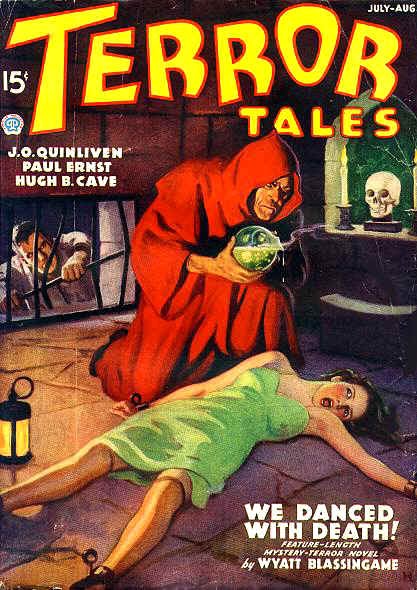
THE SHUDDER PULPS

Pulp magazines (so called because of the cheap wood pulp paper they were printed on) had their greatest popularity from the 1920s through the 1940s. Although some major writers got their start in this grind-em-out business, most of the work was on the hack level. For about nine years, from 1933 to 1941, stories of "weird menace" became popular.

These horror tales frequently featured Gothic settings, sadistic villians, torture, beautiful women in peril and seemingly supernatural scenarios that were eventually explained away at the end as being elaborate plots to deceive the unwary. The first magazine to fully exploit this formula was Dime Mystery in 1933.

Many titles followed as the public revealed a great appetite for this unsavory mix.


The lure on the newsstand were the lurid and colorful covers. Scantily clad beauties were threatened with torture, drugging, branding or worse by hooded high priests, mutant dwarfs, leering perverts or imbecilic lechers.

Rip-offs were common. Here the "Oriental Menace" is a not very subtle copy of Sax Romer's ultimate villian, Dr. Fu Manchu. Wu Fang had a run of about eight issues.

The longest lasting pulp magazine that dealt with horror subjects was "Weird Tales". Never a great success, it had however, editors devoted to quality. The lasting legacies of writers like H.P. Lovecraft, Robert E. Howard, Ray Bradbury and Robert Bloch started within its pages.

It also had a devoted readership that kept it going from 1923 to 1954; a substantial accomplishment for a fiction magazine and a near record in the pulp industry.

Saturday, April 7, 2012
Wolfman

When he realizes that he has killed a man instead of a wolf, he is again stricken with horrible guilt, as we all would be. He is even guilty for a crime which he thinks he "may" commit (harming the woman) and he desperatly tries to avert that disaster before it happens.
I get the feeling that he would have welcomed his own death, even at the hands of his father, just to free him from the guilt.
Thursday, April 5, 2012
THE BRIDE OF FRANKENSTEIN - 1935
Here are some scenes from what many consider to be the greatest of all the Universal Horrors.

An original Title Lobby Card (11x14) - extremely rare and valuable.

The Monster (Boris Karloff) in chains - but not for long.

In the Crypt - Dr. Pretorius (Ernest Thesiger) toasts the future Bride.

The Laboratory

"She's alive!" - Thesiger and Colin Clive as Henry Frankenstein.

The Bride of Frankenstein

Elsa Lanchester before...

...and after.

The Monster and his Mate.

Rejected by the Bride

Tea Time on the set - Director James Whale and Thesiger in the Crypt.


Wednesday, April 4, 2012
Son Of Frankenstein
This film was not what I expected it to be about. I liked Igor and thought he was funny as well as the child Peter. The house itself made the film more interesting. I did not like the ending it was very abrupt and I do not think after the towns people hating him so much would just start chearing him unless they were doing so because he was leaving.

Subscribe to:
Posts (Atom)